Thursday, 31 May 2012

Review: Wolverine and the X-Men #11


Wolverine and the X-Men #11 By Aaron / Bradshaw 

Perhaps more than anything else, the best way of judging a series on the up is in the way that it handles a crossover. Far from shying away from slotting this title into a much bigger conflict, Jason Aaron has managed to deliver yet another solid instalment in its tie in with Avengers Vs X-Men. After a couple of months of umming and aahing, this issue finally sees Wolverine and the X-Men joining the conflict proper, the X-Men team taking on the Avengers while Wolverine helps Hope to escape from Earth's Mightiest Heroes. Although the issue's dramatic conclusion has already been played out in the core Avengers Vs X-Men series, this issue does an admirable job of revealing the thinking behind Wolverine's decision.

While the core series, at times comes across as a somewhat slapdash, unsubstantial read, it is issues like this that do a better job of sketching out the character beats behind the - admittedly somewhat sluggish - action sequences that have punctuated the crossover so far. It is the sequences that pander to the main series that come across as weakest though, and even a writer as talented as Jason Aaron struggles to make the superhero brawls of this issue particularly interesting. What appears to be the crossover's selling point - The Avengers taking on the X-Men - has become diluted and fails to grab the imagination at roughly the story's halfway point.

It is predictably in the characterisation that Aaron really shines, and as with the rest of the series he manages to balance out the cast relatively evenly. Wolverine takes centre stage, but that is to be expected and Aaron does manage to put a newish spin on a character who is all too often reduced to little more than a poorly fleshed out caricature. Even if his decision at the end of the issue has already been spoiled, by providing the logic behind it Aaron manages to make it feel fresh and interesting.

Nick Bradshaw takes over from Chris Bachalo on art duties once more, and impresses more than in his previous stints on the series. His style lacks the abstract qualities of Bachalo's work, but is much clearer and easier to follow. His layouts are more strictly regimented too, but once again this makes for an plot that is simpler to read than some of Bachalo's more obtrusive efforts.

When left to its own devices this is an issue that shines and it is only when it gets too bogged down in the wider mechanics of the crossover that it becomes a little tiresome. Even when taken simply as a regular issue in this series though this issue manages to work surprisingly well, and even benefits from the weighty, epic nature that the storyline has been given. Solid work.

B+

Friday, 25 May 2012

Why Did The Spider-Man: Reboot Fail? Part 20: Villains Galore


The Amazing Spider-Man (Volume 2) #17 By Mackie / Byrne / Green
Peter Parker: Spider-Man (Volume 2) #17 By Mackie / Romita Jr / Hanna 

Remember the Sinister Six's return a handful of issues ago? Not the most memorable of stories but set against the rest of the Spider-titles post-reboot output, certainly a decent one. This loose two parter serves as a follow up or sorts, showing a royally pissed off Venom out for vengeance against his former team-mates.

Mackie's script begins with the Sinister Six's de-facto leader - The Sandman - who is decomposing after Venom took a bite out of him in the previous issue. There is something genuinely touching about his plight, although Paul Jenkins does a better job of dealing with it in a later issue. As the Sandman pledges to kill Mysterio, blaming his ex-team mate for his situation, the scene changes and we check in on Peter, who is on his way to a job interview. Glory Grant's appearance was a welcome surprise and it is always good to see Peter's friends looking to help him out. On his way to the interview - somewhat inevitably - Peter's moral code gets in the way, and after helping a mother rescue her baby from the bars of his own cot (yes, really) he is accidently implicated in a drugs raid on her apartment. The scene reads slightly improbably, but is genuinely quite amusing.

 Peter's captors are soon distracted by the appearance of the Sandman, who is making a nuisance of himself, gradually falling apart as he goes. After escaping and changing into his costume Peter sets off after him, before they chance upon Mysterio and Electro in an abandoned warehouse, the pair having become something of a double act. Sandman reveals that he wants Mysterio dead, as the master of illusion was the one who convinced him to allow Venom a place on the team. A brief fight ensues, before Spider-Man pulls the ceiling down on them, rushing Sandman out of the warehouse in the process and leaving him to the police. The final page reveals that, against all odds Peter managed to turn up to his interview on time, although his potential employers have already decided that he is overqualified for the position. That old Parker luck eh?

The second part follows directly on, with a well again Mysterio and Electro resolving to take down Venom before he gets the chance to attack them. Mysterio leaves and, somewhat coincidentally Venom attacks, setting upon Electro and defeating him embarrassingly quickly, in the space of just two panels. After leaving him cowering on the ground Venom leaves, with his dialogue indicating that he may have left him for dead. Although Mackie leaves his fate ambiguous, and he did eventually return, it seems an inauspicious way to treat such a powerful villain, particularly after Spider-Man's ominous (and ultimately pointless) comments about Electro being powered up in the previous issue.

The scene moves to Peter Parker, who is engaged in an awkward conversation with Jonah Jameson, the Daily Bugle head honcho still refusing to print his photos of Spider-Man. The scene reads slightly oddly, with Jonah behaving in decidedly odd fashion. It has an unsettling effect, which I suppose is kind of the point, but it doesn't quite work, with Jameson's actions coming across as mindlessly enigmatic, and Peter making a buffoon of himself. We are treated to a brief interlude, where Kraven having heard of Venom's activities, decides that he will take the fight to the villainous alien symbiote - using Spider-Man as bait! As Peter leaves the Daily Bugle he runs into Robbie, who is arguing with his son 'Randy', who it is revealed has recently gone through a divorce and moved back to New York. Robbie tries to give Peter money but he turns it down and leaves. Once again, it is good to see Peter's friends helping him out. Randy's role in the scene also works well as foreshadowing for a later plot development.

Later, while swinging across the city Spidey is caught by a poison tipped dart, and captured by Kraven. It seems a disarmingly simple way of taking him out, but we'll run with it. Spidey is strung up as bait, and Venom appears shortly (and conveniently) after. Venom is not taken in by Kraven's ruse, and the pair run off to fight, leaving Spider-Man to free himself. After interrupting the fight he tricks Venom into trapping himself in the middle of a ring of fire, before Kraven idiotically bursts through and attempts to kill the symbiote. Spider-Man intervenes, taking down Kraven while letting Venom escape. The scene's conclusion is outrageously nonsensical - after being defeated by a roll of flaming up newspaper in the previous issue, Venom is shown here walking through A WALL OF FLAME with no ill effects. It makes literally no sense, as far as I can see. The issue concludes with Peter returning to his apartment only to find that he has been evicted. Once again - that old Parker luck eh?

It is always fun to see Spidey's rogues gallery show up, and in that respect this two parter works well. The Sinister Six are all visually striking foes (although Electro's new costume is very bland) and they generally look great here. Ultimately though, the story doesn't really work. None of the villain's motivations are particularly strong and it quickly devolves into everyone trying to kill each other with Spider-Man stuck in the middle. Mysterio and Electro's connection is poorly defined and never mentioned again, and Sandman's initially heartbreaking circumstances are undermined by his perplexing desire to kill Mysterio. Mackie's dialogue is largely uninspired too, and does little to convince.

The 'Parker luck' theme is beginning to feel overdone as well. Although it is, to some extent, a hallmark of the character it has felt like overkill in recent issues, and Peter's personal life has become an unrelenting stream of misery. While it is nice to see his supporting cast looking out for him, it is beginning to feel a little samey and depressing.

The artwork is a mixed bag. John Byrne's pencils are predictably erratic, with some nice renditions of the characters mixed in with some lacklustre panels and missing backgrounds. Even Romita Jr's usually reliable artwork feels off form, and is a little too sketchy for my liking in patches. His Venom seems to have changed too, and taken on a more wiry physique with absolutely huge hands. It doesn't really work for me.

Although this is, on some levels, a fun, action packed couple of issues, it is unable to boast an intriguing plot, believable characters or witty dialogue. There is nothing irredeemably awful about this two parter, it just doesn't really work on any conceivable level.

C-

Wednesday, 23 May 2012

Review: Batman Incorporated #1


 Batman Incorporated #1 By Morrison / Burnham 

The Batman corner of the DC Universe seems so awash with hype for the 'Night of the Owls' crossover, that the launch of this unconnected (so far) series has flown a little under the radar, despite the presence of superstar writer Grant Morrison. It's lack of connection to Night of the Owls is initially a little jarring, but to Morrison's credit he has managed to tell a compelling opening chapter without stepping on any of the other Bat-writers toes too much.

The plot of this first issue is hugely rich, and packed with layers that gradually begin to unravel as its plot progresses. It isn't obviously tied to the other Bat-titles currently being published, but uses them to further its ambitions. There is reference for example to the recent opening arc of Batman and Robin and to Dick Grayson's stint as the Caped Crusader. These are small details, but they add a depth to the story and a feeling of interconnectedness that is often absent from more self contained arcs. Morrison gets right to the heart of what makes Batman such a great character here too - there is intrigue, suspense and a set of rivetingly macabre villains.

Chris Burnham's pencils straddle the fine line between cartoony and realistic, a balance that it is difficult to meet correctly. He manages it with aplomb however, and his work here is varied and detailed throughout, aided by some great colours from Nathan Fairbarn. Some of his layouts are excellent too, and some fine storytelling skills are displayed across the issue.

This may not be tied as closely to D.C's New 52 as other series' are, but as the issue gradually reveals, it promises to be a series that will be highly significant for Batman's world. Chris Burnham's art is excellent, and Morrison's script is straightforward and easy to follow,while still containing the wacky touches that make him such an interesting writer. A very strong start.

A-


Tuesday, 22 May 2012

Why Did The Spider-Man Reboot Fail? Part 19: Cliche


Amazing Spider-Man (Volume 2) #16 By Mackie / Byrne / Green
Peter Parker: Spider-Man (Volume 2) #16 By Mackie / Romita / Hanna 


Perhaps moreso than any other aspect of the reboot, Peter Parker's job at Tricorp, introduced with much fanfare in #1 of the second volume of Amazing Spider-Man, stands as a complete and utter failure. Despite the job making a lot of sense - so much so that it was effectively re-used in Dan Slott's recent run - Mackie appeared reluctant to actually use it, and the subplot was quickly shuffled to one side, with Peter even ending up spending more time at the Daily Bugle.

It is with this issue that Peter's time at Tricorp finally draws to a close, a long and painful demise rather than the quick, clean one that it really should have been. The issue is also a crossover of sorts with the long since forgotten Marvel: The Lost Generation mini series, a fact that does nothing to endear me to it.

The issue begins with the resurrection of a familiar Spider-Man trope - money problems! It turns out that MJ and Peter were not as financially secure as he was led to believe and Aunt May reveals that after her death Mary Jane's former manager has made off with her money, leaving Peter with several bills that he can't pay. Peter is left homeless, and eventually jobless as he turns up at Tricorp only to be told by a bewildered Doctor Twaki that he no longer has a job there.

Peter's money problems, while perhaps being unnecessary extra misery to dump on him ring more true than his status as the mega rich husband of a supermodel. I am not quite of the school of thought that Peter's character is heavily reliant on his status as an everyman, but I felt that his and MJ's lavish lifestyle in the earlier reboot issues strayed a little too far away from the core of the character. Returning him to a more meagre existence, to me leaves Peter as a more recognisable character. I appreciated Mackie taking the time to round off Peter's job at Tricorp, although the execution did make him come across as slightly clueless and stupid. Given the way he has approached the job however, that isn't much of a surprise, and I'm not really sure how else Mackie could have gone about it. While at Tricorp Spidey is called into action to tangle with the industrial saboteur known as 'Ghost', but this is a fairly forgettable fight scene by numbers. The appearance of time travelling historian Cassandra Locke is slightly unnecessary, but does make for a couple of mildly clever pieces of dialogue.

The issue ends with Jonah revealing that he will not be accepting any photos of Spider-Man from Peter, further deepening his financial woes. Jameson's somewhat abrupt decision harks back to a scene a few issues back where he had the opportunity to look under an unconscious Spider-Man's mask - could he have finally learned of Peter Parker's duel life? Probably not, but we'll get to that in a few issues time.

This is a very forgettable issue all around, although it does a good job of manoeuvring Peter's status quo into a more recognisable position. The termination of his job at Tricorp was necessary, and removing his and MJ's wealth initially seemed like a good move too. With Dan Green's inks lending a bit of welcome detail and depth to Byrne's often sketchy pencils, this stands as a fairly decent, if unspectacular reboot issue.

B-


The next issue is slightly more interesting, and shows Howard Mackie to be a much more talented Spider-scribe than he is often given credit for. Titled 'Cliche', it approaches a typical day in the life of a newly penniless Peter Parker, who after foiling a group of armored terrorists robbing a bank returns 'home' to a grubby motel, after having moved out of his and MJ's plush apartment. Peter heads out again as Spider-Man, and tussles with a group of amusingly generic supervillains, calling themselves 'The Wicked Brigade'. Although they are self referentially lame, there are actually a couple of decent designs in there and 'The Squid' has since gone on to make a couple more appearances.

After the group are blasted by yet another generic looking supervillain - this one the Doctor Doom like 'Master Monarch' - Spidey swings by to the Daily Bugle, where he finds the staff hiding away from Venom who has taken them hostage. John Romita Jr was born to draw Venom, and the villain is at his creepy best here, as the pair fight and trade a few relatively well written quips. Sandman soon shows up, and Venom reveals that he still bears a grudge against him after the pairs brief membership of the Sinister Six (in #12 of both titles if you're counting). He proceeds to take a huge bite out of the Sandman who slides off, appearing in deep discomfort.

Spidey and Venom continue their fight for a bit before Spidey defeats him using a rolled up newspaper and fire. Typically, Jameson still blames Spider-Man for everything, and he webs the embittered publisher's mouth shut and swings off. After briefly resolving to quit the crime fighting business after a rotten day at the office, Peter decides against it, revealing that 'being Spider-Man is kinda cool'. The issue ends with Spidey running into the Thing, and the pair on the verge of a typical hero vs hero duel.

Although the issue probably doesn't sound like anything much that is sort of the point. Mackie plays with a number of super hero cliches in a pleasingly knowing fashion. Spider-Man's interior narration through the issue is well written, and actually often quite funny. Romita Jr's pencils are excellent too - moody, dynamic and rich, with excellent renditions of both Venom and Sandman, and even some impressively drawn throwaway villains. In many ways this is Mackie's strongest rendition of the Web Slinger since the reboot began which does beg the question - why can't he write like this every week?

A-

Saturday, 19 May 2012

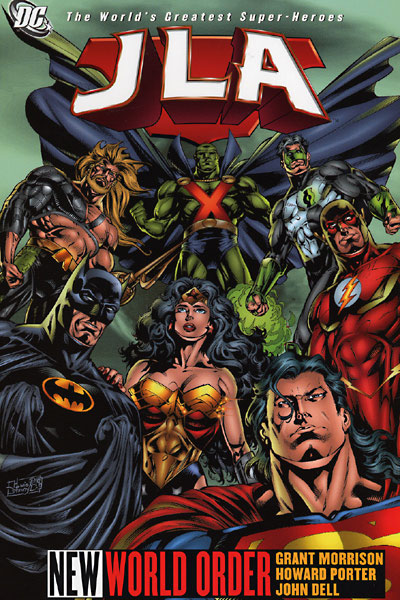
Review: Grant Morrison's J.L.A: New World Order


JLA #1-4 By Morrison / Porter/ Dell


In a climate where the Justice League is one of the hottest titles around, boasting a superstar creative team and positioned at the centre of the D.C Universe, it is sometimes difficult to imagine a time when it was languishing in terms of both popularity and acclaim. In the early to mid 1990's though, that was very much the case. The team was split into several different incarnations, including Justice League: International, Justice League: Europe and the very 90's sounding Extreme Justice. Although the tactic initially proved relatively popular with Keith Giffen and J.M DeMatteis earning plaudits for their initial run on Justice League: International, after their departure the titles  steadily waned, until Grant Morrison and John Dell were brought in to restore what should be a flagship title for D.C to the level of popularity that it deserves.

World Order sees the 'Big Seven' - Superman, Batman, Wonder Woman, The Flash, Green Lantern, Aquaman and Martian Manhunter - together again for the first time since the mid 1980's, reunited to stop a mysterious cabal of aliens from taking over the world. The plot has its fair share of twists and turns, but at its heart it is as conventional as it sounds, and four issue running length aside would not have been out of place in the Silver Age. This is a portrayal of the team tailored to the mainstream, with the likes of Green Lantern and Aquaman pushed to one side to allow starring roles for Batman and Superman - although Martian Manhunter is refreshingly granted some time in the spotlight. That is not necessarily a bad thing of course, and as an introduction to the team this arc works well enough. There is little characterisation, but the various members of the team are fleshed out enough to ensure that they are not simply ciphers. There is little depth to be found in most of them yet, but that allows the focus to be placed squarely on Morrison's larger than life plot.

This is a fairly progressive take on the tired 'Aliens invade' plot template, although it is hardly the sort of high concept stuff that Morrison has become so famed for. The arc is paced in breakneck fashion, and although there are some very interesting ideas on show they are never really given much space to breathe. The action though, never lets up, and this is a story in the classic comic book tradition from the first page onwards. The heroes are larger than life and the villains are dastardly wretches, although there hints at modernisation - the civillians of the story have a larger role to play than the mindless fodder than they are often characterised as, although it only becomes apparent nearer to the story's end.

In modern day terms, this is a story that feels a little bit dated. The appeal of seeing the big seven together again has worn off, and there is little about the dialogue or characterisation to drag a bog standard plot up from mediocrity. Howard Porter's pencils are solid, and suit the story to a teen, but feel steeped in the sort of the 90's iconography that is viewed with suspicion today. This is a fun enough superhero story, but I expected more from the radical comic book storyteller that Grant Morrison has proved himself to be.

C

Thursday, 17 May 2012

Review: Avengers Vs X-Men Round 4


A VS X Round 4 By Hickman (Script) / Aaron / Bendis / Brubaker / Fraction / Romita 


It is quite strange to feel as though it is my own fault that I haven't particularly enjoyed a comic book. Really, I should not have much expected much more from Avengers Vs X-Men - and when you stack it up against past events there is little to choose from between them. Perhaps they are simply not for me. It is hard to shake the feeling however that this series is less than the sum of its parts. Composed by a group of Marvel's top writers, with pencils supplied by arguably the top artist in modern comics (arguably guys, arguably) this is a blockbuster series if there ever was one, and that is without mentioning the fact that it starts virtually every single major Marvel character, several of which in direct competition with each other. I

Once again the issue's core plot deals with Wolverine hunting down Hope, and eventually leading her to the Moon, where we are greeted with another confrontation between the Avengers and the X-Men, with an ominous looking Phoenix force bearing down on them from above. The issue opens well enough and Wolverine's role in the series has been by far its most interesting facet. His relationship with Hope promises much, but ultimately proves to be a disappointment. Pairing Logan with somewhat more vulnerable female characters has worked well enough in the past but her character is not given enough depth to make their interactions, or even her wider fate remotely compelling.

Much of the rest of the issue is extremely disjointed, and utilises the irritating tactic of reminding readers that several events significant to the series' wider plot are taking place in other titles. As a result, this issue has a half finished quality to it that is reminiscent of most recent Marvel events. The main plot is clear enough however, but unfortunately fails to do anything particularly exciting, despite a series of plot twists. Character work is scant, and even the cliffhanger fails to impress, given the Phoenix Force's presence throughout the rest of the series.

This series is all too quickly falling afoul of the same criticisms that made Fear Itself such a laborious read for me, although Romita Jr's artwork is far more uneven than Stuart Immonen's beautiful pencils on last years event. There is still time to save Avengers Vs X-Men, but a pedestrian, disjointed issue has done little to whet my appetite for its concluding six issues.

D+

Wednesday, 16 May 2012

Why Did The Spider-Man Reboot Fail? Part 18: Doomed Again


Peter Parker: Spider-Man (volume 2) #14 By Mackie / Romita Jr. / Hanna

Although the previous issue of Amazing Spider-Man allowed readers a glimpse at Peter Parker after learning of MJ’s death, it hardly gave us an emotional reaction, choosing instead to focus on Spider-Woman, a character who even her most ardent fans would admit seemed completely out of place. This issue is a little more like it, and begins with Aunt May preparing a meal for Peter and Mary Jane’s friends, with the scene shifting across to see how various members of the supporting cast are handling her death. It is brief, but handled very well by Mackie. Spider-Man’s supporting cast is one of the best in comic book history when used correctly, and this issue certainly stands as an example of that.

Peter Parker however is not helping his aunt prepare the meal, instead choosing to spend his time trading blows with the Incredible Hulk, who he confusingly seems to have blamed for MJ’s plane crash. It isn’t explained particularly well and seems like a humungous leap of logic, although it does set up a fairly visually spectacular fight sequence between Spider-Man and the jade giant. Peter is still in denial, and at this point it seems like a realistic reaction for a character who has experienced as many returns from the grave as he has. The characters trade blows, in the process destroying a set of train tracks.

In the meantime, Peter and Mary Jane’s friends arrive at the meal, and comfort a flustered Aunt May. This is a particularly touching scene, and somewhat surprisingly Mackie’s dialogue is excellent, in an understated sort of way. The rest of the issue cuts between the two scenes, with both working well in entirely different ways. Eventually Spidey and the Hulk hear a train coming and decide to patch up their differences and repair the train tracks that they wrecked together. It’s a fairly convenient end to the issue, but one that works well in the context of such an emotionally driven plot. The Hulk's characterisation is dead on, and a lot more nuanced than it often is. Peter returns home to Aunt May and apologies for missing the meal, before reiterating his belief that MJ is not truly dead. The issue concludes with Peter receiving a mysterious phone call in the middle of the night, simply saying ‘She’s alive’.

Unfortunately the conclusion rather ruins what had been a quietly excellent issue from Mackie and Romita. Giant leap of logic from Peter aside, his fight with the Hulk was terrifically rendered by Romita, with enough character work behind it to make it interesting on a number of levels. The dinner scene worked well as a way of bringing Peter’s supporting cast into the story, and all the characters rang true throughout the scene. The final three panels, although a tiny part of the issue undermines it somewhat, and come across as a cheap way of dragging the plot out and reiterating Peter's belief that his wife is still alive. Despite this, this is still an impressive issue that seems to have been lost in the shuffle in subsequent years – somewhat understandably so.

B+

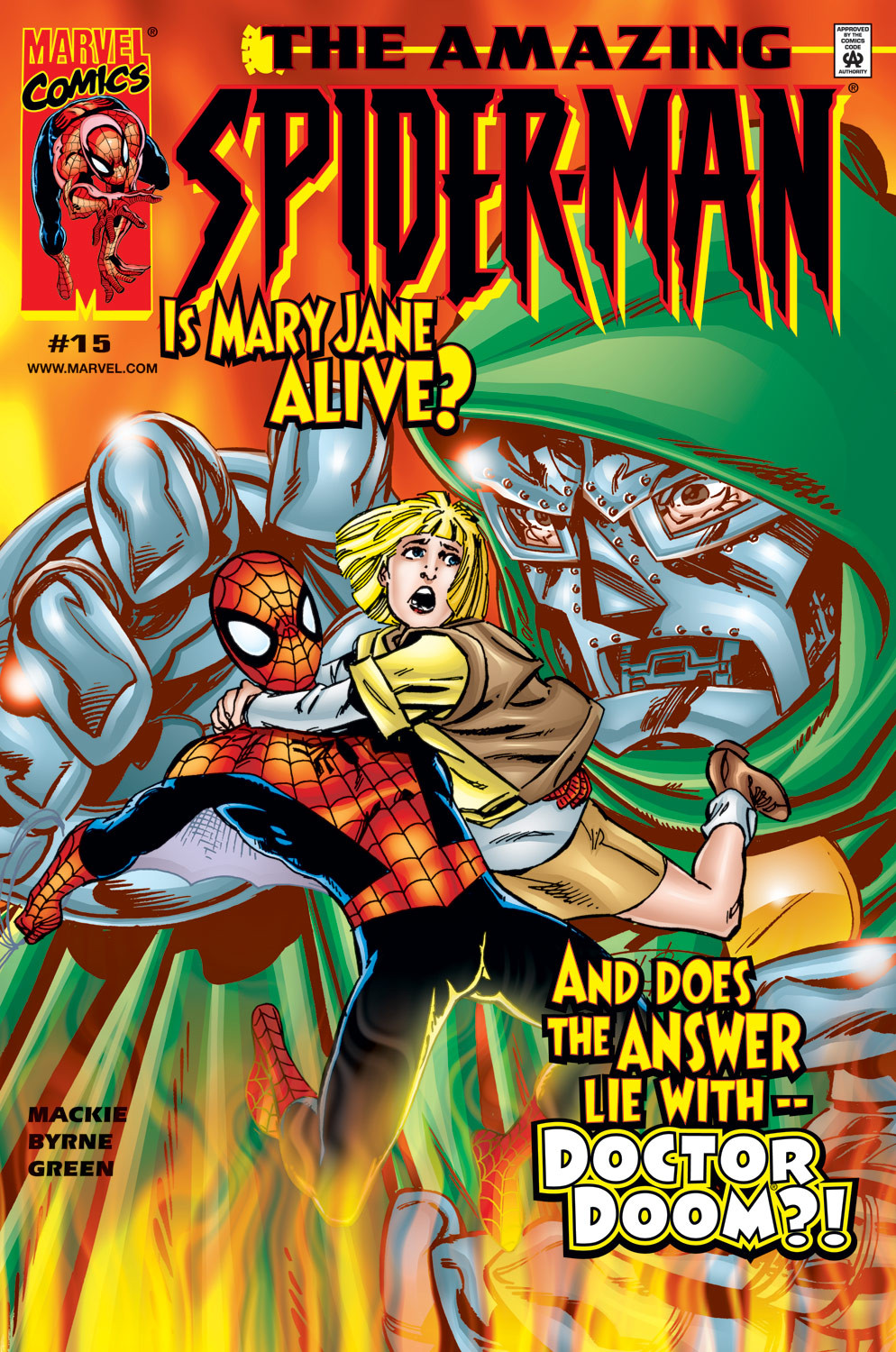
Amazing Spider-Man (volume 2) #15 By Mackie / Byrne / Green


Peter Parker Spider-Man (volume 2) #15 By Mackie / Romita Jr. / Hanna

Although Doctor Doom is broadly known as an adversary of the Fantastic Four, he actually went toe to toe with our favourite Web-Slinger in just the fifth issue of Amazing Spider-Man. This two parter sees famed Fantastic Four writer John Byrne tackle a character that made up a relatively small part of his acclaimed run on the series, albeit in slightly less impressive style.

Following the enigmatic phone call he received at the end of the previous issue a dogged Peter heads to Latveria determined to prove that Mary Jane is alive. Why Latveria? As Peter recounts in a brief flashback sequence, the fictional Eastern European nation ruled by Doctor Doom was the destination for the flight on which Mary Jane supposedly lost her life. After arriving in the country, Peter (in full webbed attire) heads to castle Von Doom in an attempt to find her. He is chased off by robotic guards led by Doom himself and soon hooks up with a female rebel whose father is being held hostage in the castle. After having had the ails of the country recounted to him, Spider-Man goes straight back to the castle, and is once again attacked by Doom. After a brief skirmish he manages to knock his head off, revealing that he is actually a robot. The headless Doombot blasts him right out of the castle and he finds Anna again, revealing that he ‘has a plan’.

The second part begins with the Doombot undergoing repairs while ordering his men to track down and kill Spider-Man. Romita Jr takes over art duties for this issue, and the opening is probably the highlight of the arc, with the Doombot actually coming across as a genuinely impressive figure. Doom’s men begin to open fire on sections of Latveria, and Anna has to stop Spidey from going out to help. He changes into his civvies, with Anna logically reminding him that his secret identity is relatively meaningless in Latveria. The pair of them leave the town - Peter destroying a troublesome robot along the way – and enter the countryside. Why? I have no idea. After Peter sees yet more devastation being caused he immediately changes into his costume and heads back into the town, where a crazed and apparently malfunctioning Doombot is turning on its own followers, and is about to execute Anna’s father. Spider-Man swings in and battles the Doombot for a few pages, eventually destroying it. He rescues the rebel leader and resolves to leave Latveria, bemoaning the time that he has wasted in finding his ‘dead’ wife.

This two parter is genuinely a bit of a mess. The plot is very uninspired, and in places makes little sense. Although the plot sounds fairly complicated it actually feels padded out to fit into two issues and is poorly paced throughout. Peter seems to forget about his search for Mary Jane very quickly, and his characterisation does not seem like that of a man who has recently lost his wife. Visually speaking the Doombot is a good villain, and he is well drawn by Byrne (predictably) and Romita Jr across the two issues. His motivations are non existent, but it seems as though that is sort of the point, and his showdown with Spider-Man in part two actually feels quite intense, moreso than it has any real right to. As a character I genuinely liked Anna, but her, her father and the rebels in general are all very forgettable.
It still feels as though Peter has not properly reacted to MJ’s death, and after three issues his state of denial is beginning to wear thin. A paper thin plot and forgettable characters do nothing to detract from what continues to be an aftermath that is beginning to get tiresome.

D+